Sunday, September 24, 2017

All that goes into a Kyrgyz lasagna

Last time I was in Bishkek I was wandering through one of the international food stores I frequent and noticed a package of lasagna on one of the shelves. Foolishly, I purchased the lasagna noodles, knowing that it is impossible to get all the ingredients in Kyrgyzstan to build a proper lasagna. Perhaps I made this rash purchase because I have come to realize that if the likelihood of perfection is the prerequisite one must meet before starting any task, then nothing would ever happen in this world.

Finding a decent sauce was no issue. I purchased a jar of Italian Bolognese and augmented it with some garlic, onion, and mild fresh pepper. I also remembered I had a bit of red wine in my refrigerator: adding a little cabernet will rescue even the most ill-conceived red sauce.

The cheese was a more difficult issue as I have never seen Ricotta in Kyrgyzstan, the cheese that is the foundation of an authentic, southern Italian lasagna. I was forced to purchase Mascarpone, a variant of cream-cheese better suited for desserts like tiramisu. I also couldn't find mozzarella, another essential ingredient. I was saved by Bolot in the campus kitchen who happened to have a package of Buffalo Mozzarella that he gave me on the day of the lasagna baking, when I realized, in a slight panic, that I hadn't yet acquired the second essential lasagna cheese. Gift: it is an important ingredient of so much we do in life, including the making a Kyrgyz lasagna.

I could have gone full-Kyrgyz and browned up some lamb to serve as the meat, but my years living in Italy prevented me from committing such an act. The Bolognese sauce had a trace of meat, which would suffice. Luckily, I had found a package of fresh Kyrgyz mushrooms while in Bishkek that I could sauté in olive oil and thyme before adding to my lasagna to serve as a substitute.

What is as important as what goes into a lasagna is what is kept out. I remember, as a boy, at church potlucks consuming lasagnas loaded with cottage cheese. How sinful to add this abomination to lasagna, especially in a place where God is worshiped. Even He would tell you that if you are going to eat lasagna, you must not worry about fat content and calories, but instead should enjoy the dish in its intended, divine glory. Same with adding a cornucopia of vegetables: if you want to add zucchini and spinach, then you should make a quiche.

History, practice, intuition, love, care, experience--those intangibles are also crucial to making a Kyrgyz lasagna. Watching my mother make lasagnas when I was a child, lessons I have learned in Italian kitchens, the feel of stacking sheets of pasta upon each other and the art of assembling each and every layer, observing the lasagna bubbling in the oven and realizing when the surface gains exactly the right golden crispiness needed for the lasagna to be taken from the oven: these are the lessons that must be applied to deliver to the table something that can be savored.

Actually there is one last ingredient all lasagnas must contain, even a makeshift Kyrgyz version, to be enjoyed to their fullest. That, of course, is company to share it with. And I was blessed today to have the best of that ingredient. I was able to share my humble offering with a very dear friend who will be departing from this mountainous land in much too short a time. Thankfully, over lasagna, a creation first created centuries ago in Naples, we were able to consider our friendship, the past, the present, and what the future might have to offer. It is that final ingredient of fellowship and conviviality that all good food shares in common and that gives life a deeper, more-delicious meaning.


Friday, September 22, 2017

The Shortest Season

Autumn is the shortest season in Kyrgyzstan, or so it feels to me. Summer has ended and the evenings now contain a distinct chill reminding us winter is approaching. Snow could hit us in less than a month, meaning the Fall season lasts about six weeks here in the Kyrgyz mountains. If one is lucky.

I've always enjoyed autumn, its mild weather, and the brilliant colors of the changing foliage. The flavors of autumn arrived today in our dining hall in the form of a mellow bowl of pumpkin soup. Apples and the last orchard fruits are making their appearance. It is a bittersweet season--celebration of the harvest accompanied by the knowledge that bleak winter is lurking close by. It is indeed the season of lengthening shadows and the time of realization that the days of warmth and brightness are disappearing.

Fall is the season where one of the emotions I feel most profoundly is an overpowering sense of inevitability. Fall tells us that there is no escape from that which is approaching. In some ways it is a season more difficult to deal with than winter itself, because when one meets the frozen winter air, there is nothing left to do but endure it and cope with it. The reality is easier to bundle up against than the unknown cold that one imagines and dreads on a gentle autumnal day. It is a typical human response to fail to enjoy the fall, as we worry about the winter. Autumn is so beautiful and short here in Kyrgyzstan that it would be a shame not to enjoy it. And so I did for a moment or two today as I stood out on the third floor campus terrace and took in a giant breath of autumn air, listened to the Naryn River rush along its unchanging course, and watched the golden light of the season drift across the nearby Red Mountains.

Inevitability. It is not just that of the seasons that I considered, when standing out upon the terrace. Other inevitabilities can trouble one as well. No matter. The precious sliver of autumn I had grasped today was just enough for me to experience some small contentment and to gather a fraction of the courage I might need to face the coming winter winds.

Inside versus Outside


In any group, collection of people, social organization, community, town or nation I have found that people fall under one of two categories: inside or outside. I know that this has been the case for me in my life. In every group, whether large or small, I have been either inside or outside--there is never any in-between.

When I lived in Arkansas, I always felt outside. I don't think I was ever invited to dinner by any person in the community I lived in who was born in the town in which I lived. I was definitely outside to them: no Arkansas accent, didn't loudly proclaim Christ as my Lord, didn't root for the Arkansas Razorbacks football team. Outside.

But there were kind people in that Arkansas community who did invite me to dinner and did nice things for me: they were all outside too, not a single person from the town inside that group. I was inside the group of outside people.

Same when I lived in Kentucky. I was definitely outside. So were all my friends. Inside the outsiders club.

When I lived in the Castle in the Netherlands, everyone in the community there treated me as though I was one of them. I was inside. I was also part of a close-knit community of students and staff in the Castle too. Inside again. I also was treated well by the government there as a legal immigrant worker and found myself very much in sync with the customs and beliefs of the Dutch--a stranger, yet an insider. Perhaps that's why I enjoyed my experience in the Netherlands so much and why the Netherlands is a good place to live--the focus is often on bringing people inside.

Japan, despite kind people here and there--I was as outside as a person could possibly be. With my looks, being only one of four white people in a community of over 100,000--I could not hide my outsideness from anyone. Actually, being completely outside, and openly despised by some in the community, can be a good experience: it makes you humble and empathetic with outsiders in your home community.

Where I live now, I am clearly an outsider judging by the looks I receive when I walk through the city bazaar. I am blessed, though, to feel inside, in the campus community in which I live and I love having a job where it is part of my mission to do whatever I can to help those with whom I live feel a sense of "insideness."

America. Used to be inside, but when I watch Nazis openly marching through America supported by the President and watch the foundations of American Democracy being destroyed by today's version of fascists, I am suddenly very much an outsider, an alien in my own land.

Inside and outside. I realize too that it just might be the great test of virtually all religions: treating the outsider as an insider is what distinguishes the righteous from the wicked.

Indeed solving the inside versus outside problem is the key to the fate of humanity: if we don't take care of everyone both inside and outside our individual circles and if we can't see that our destiny is tied to both inside and out, we run the risk of all of us destroyed in a world where no circle can be insulated completely.

Let us all bring together, inside of our communities and groups, those who are outside and let us all work together for the common good. Ultimately it will bring us to a better place than where we might end up if our energy is used to keep those we perceive as outsiders out.


What is real and what is unreal

(Originally written, September 9)

As I was riding back on the bus from our student excursion late this afternoon, I was attempting to read the signs on the shops we passed by. It's not like reading signs in the U.S., as in Kyrgyzstan I am trying to decipher the Cyrillic alphabet.

It doesn't seem real, living in this land where the alphabet seems backward and my brain seems dyslexic.

One of the signs I could read clearly was the street sign of the main street of town, the street I live on: Lenin Street. Once, very early in my life, I lived on a street named after U.S. President Andrew Jackson, now I live on a street named after the founder of the Soviet Union. Our bus continued toward the campus, maneuvering a couple of times to miss a sheep or a wayward cow. Never have I lived in a place where livestock is the most common roadside hazard.

Staring at the Cyrillic alphabet, stories of super hurricanes on the other side of the the world, listening to Kyrgyz legends, Donald Trump, gazing at images of Lenin, drinking horse milk, watching Nazis march through America, my primary caregiver the gynecologist, living at -42 below: I sometimes feel as though I have lost track of what is real and what is unreal.

Sorting out what is real is always a challenge for those of us living far away from the familiar. Boise can be unsettling for someone from Manhattan, but the contrast I am experiencing between the opposite ends of the earth sometimes is as breathtaking as exercising at the high altitude where I live. My strategy for dealing with the effort to determine what feels real, is generally to ignore the entire question. "What is real is what is in front of me, with no thought required," seems the best road to travel when I'm feeling troubled by a hint of unreality. Yet every time I see an image of the flooding in Houston or hear the phrase "President Trump" or sit in my apartment watching Russian television, or look at where Kyrgyzstan is situated on the map of the world and realize that's where I am too, I wonder if reality is becoming slightly unhinged.

Perhaps that is why someone like Donald Trump can get elected. When people have trouble coping with what feels like daily intrusions of unreality disturbing and upending their mental picture of the world and how it should be, their feelings of discomfort cause them to take drastic steps, engage in rash actions. Perhaps that explains certain jarring behaviors I have witnessed on this side of the world too?

After much thought, I have realized that, though I sometimes feel that aspects of the world seem precariously unreal, that trying to sort out what is real is a hopeless endeavor. It is a duality that can only aggravate and perplex whomever tries to sort it. Maybe the effort to unravel this duality is impossible because there actually is no duality at all, in that everything we encounter is real, despite the temptation to label "unreal" that which is alien to our experience. The Cyrillic alphabet is no less real than the Roman alphabet--what is problematic is I was raised with one and not the other. It is our position in the world that shapes how we perceive what is real. If only all of us, Trump voters, myself, and each and every person, could simply realize that we have to reposition ourselves and our perspectives constantly to avoid this feeling of unreality. Easier said than done.

I feel better, more grounded in my personal reality, now that I have finished mulling over my feelings of unreality. I am off to participate in a celebration of the Independence Day of Tajikistan with my students. How unreal is such celebrating for someone born in the U.S.A. who was barely aware of Tajikistan's existence until two years ago? Yet how very real too, as these festivities carry many of the same meanings for the Tajiks I'm living among as they would for me on the 4th of July. Even more unreal is that I feel as closely connected to the Tajiks I know as I do to any of the Americans I know, yet that connection, though on the surface seems unreal, is certainly as real as anything I currently experience in my life. To embrace paradox, realize that perceptions of unreality/reality are all variations of the same experience, and to accept the unity of it all, what a difficult challenge it is. And facing that challenge with bravery, mindfulness, and a spirit of adaptability and resilience might be what distinguishes those who thrive in the world in a spirit of joy, as opposed to those who do not.

Tuesday, September 5, 2017

O-Crew Rocks!

The O-Crew

Pictured here is the Orientation Crew comprised of second year UCA students and the Student Life Staff.  The O-Crew built, planned, designed, and delivered Orientation to our new UCA students.  What an amazing and talented group.  They did a super job and put together eight days of amazing activities and learning experiences for our newcomers. 

Here's what's coolest about this group.  They come from Afghanistan, Pakistan, Kyrgyzstan, Kazakhstan, and Tajikistan.  And there's one other American on the crew besides me.  Can you recognize that person in the picture?  If you have never met us, I bet you can't.  That's what I love about this photo:  it was taken at the World Cafe event we conducted that featured discussions of culture and how we build a positive, pluralistic culture on our campus.  Nationality is confused and doesn't matter--we are all wearing each other's clothing and cultural artifacts and we are celebrating everyone's cultures and identities.  I mean, look at me:  I am proudly wearing the traditional hat my Pakistani students gave me. How strange it is that we are celebrating diversity in the mountains of Kyrgyzstan, while the President of the United States is supporting neo-fascists who are hoping to destroy the diverse melting pot that is America.  It makes me shake my head as I contemplate what my nation has become.

I think any person who ever had the chance to be part of a talented, diverse, and downright pleasant O-Crew like the one I've been blessed to be a part of, couldn't help but be a little bit more appreciative of other cultures and the idea that we are not necessarily defined by our ethnicity, but by what is inside our hearts and minds.  

Wednesday, August 2, 2017

Song Kul

This past weekend the Student Life Team and new math faculty went on an expedition to Song Kul, the second largest lake in Kyrgyzstan. Song Kul is a rugged three-hour journey from Naryn. The lake is situated in a high alpine basin (over 3000 meters in elevation). What is most striking is the extraordinary expansive sky that one views while gazing across the lake into the mountainous horizon.

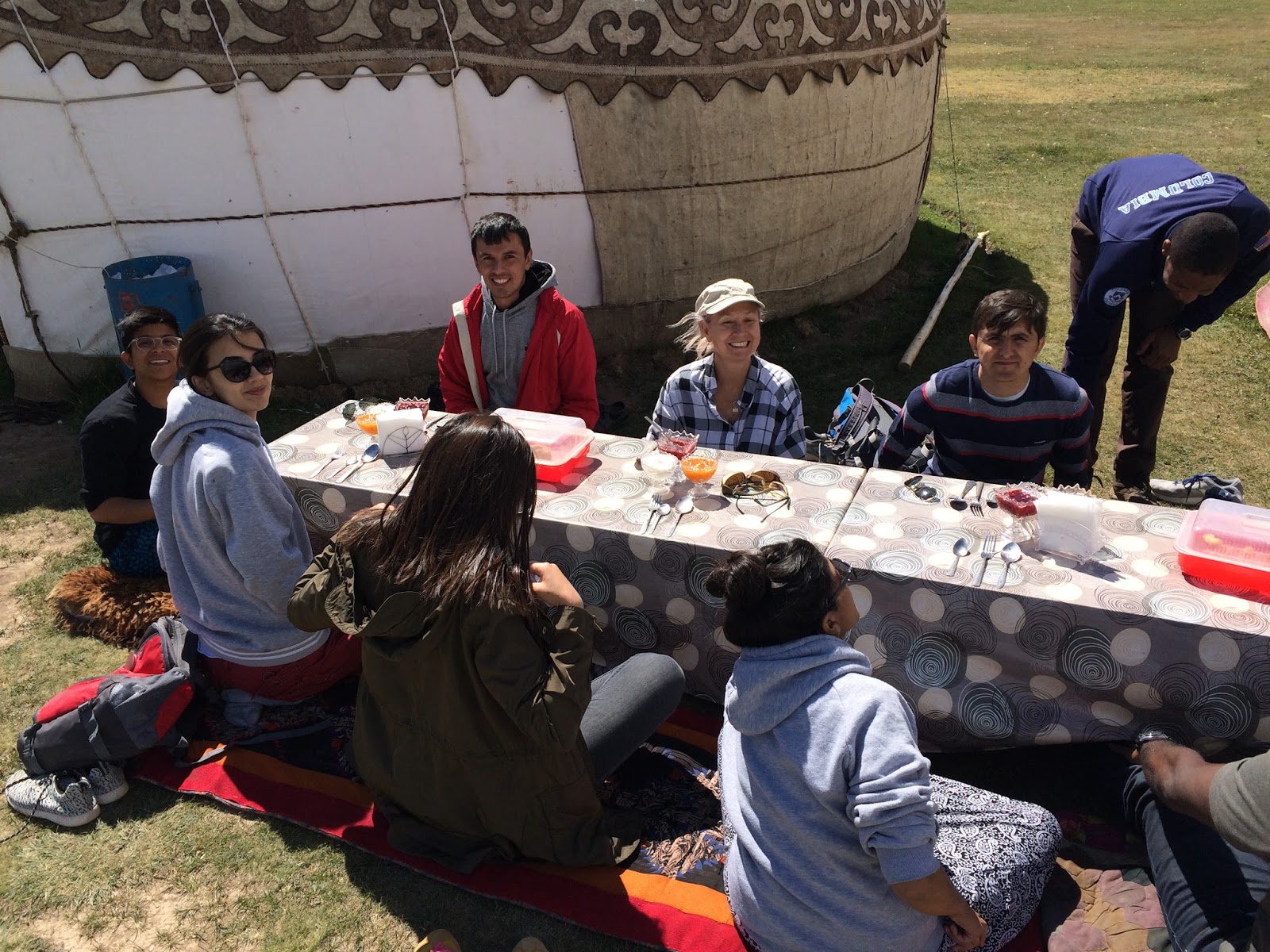
We spent our three hours there enjoying the lake, riding horses, witnessing modern nomadic culture, experiencing life in a yurt village, and enjoying a wonderful meal prepared by a Kyrgyz family. And it was especially fun to spend some time with colleagues now departed to new assignments and with those soon leaving--all of whom I treasure greatly.


The extraordinary sky at Song Kul

Ready for our home meal prepared by a Kyrgyz family

Song Kul

Traditional yurts

The Road to Song Kul:  a rough gravel road with endless switchbacks

Members of the new Khorog Student Life Team skipping stones

One of the yurt villages at Song Kul

The two young boys whose lakeside business was selling horseback rides to us.

Friday, July 21, 2017

On Fire at the Barber Shop

Today I came down from my vacation refuge in the mountains, for one more day of respite before I head back to work in Naryn. Because I had forgotten to pack my beard trimmer almost three weeks ago when I left my home, I was looking even more unkempt than I usually do, so one of the first things on my to-do list was to visit Mr. Nice, my Bishkek barber shop.

Of course, I was assigned the one barber who couldn't speak English, so I communicated as best I could by using Google Translate on my phone to get my wishes known: medium cut, not too short, parted on the left, trim the beard, not too short either, shave the hair in my ears, shave my neck.
 
Forty minutes into my haircut, eyes closed as I always have them when getting my hair trimmed, mind drifting toward pleasant thoughts of sublime moments, I suddenly felt a blast of scorching heat in my ear. In a flash, my eyes opened as wide a saucers to witness my barber waving a stick of burning flame inside my left ear.

When someone sets your ear on fire unexpectedly, there's not much to do, except hope the damage isn't permanent. One thing I did do, was notice that the aroma of burning ear hair is not a scent that inspires gladness or nostalgia for anything at all. Although the surprise had diminished by the time my barber set my right ear ablaze, a small sense of horror remained, the kind of fear possibly experienced by early Neanderthal tenders of fire, when they realized they had something slightly frightening at their disposal.

It turns out that my barber was not a sadistic sort, but instead was engaging in a practice that began in Turkey hundreds of years ago called singeing. Turkish barbers, for various antiquated reasons, used fire to cut people's hair. And over time, the practice remained in place for removing hair from sensitive places like ears that can bleed like geysers when accidentally cut.

After I left Mr. Nice, still smelling a bit charred and smoky, I considered the peculiarities of men and their hair. Whatever enterprising chemist figures out the chemical process that suddenly causes hair to grow in men's ears and applies it to growing it on their heads--that chemist will win a Nobel Prize and earn billions. And me--I have another story of an unnerving visit to the barber to add to my collection.

My barber at Mr. Nice demonstrating the art of singeing after my visit.